Vanessa Pacheco
The Knowledge Comes From Us
RE-AMP | Lafayette, Indiana
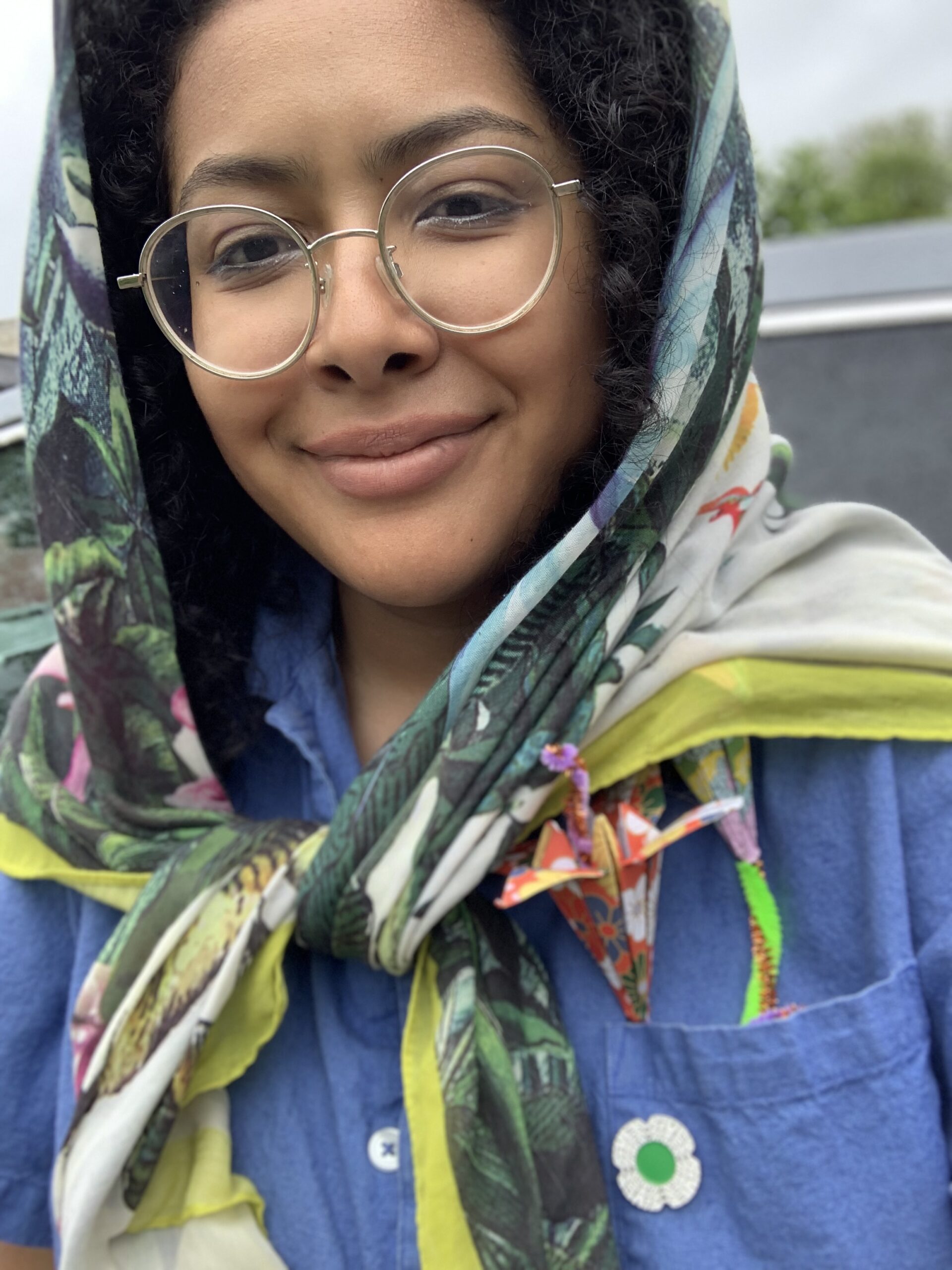
Growing up in the Inland Empire, (with parents from Compton and East LA), my sense of the natural world was shaped by witnessing and experiencing the impact of extraction. Now, I live in Indiana, where I see how the same pollution and poisoning is impacting historic Black communities in East Chicago, Gary, and Hammond.
In a capitalist society, we are collectively taught, and often forced, to devalue Black, poor and Indigenous life to ensure our own survival. Within this context of exploitation, the material comforts that make life livable (an extra sweater in the fall, cool air in the hottest week of the year) have become increasingly harder to get without the destruction of our planet and our siblings across the world. For some of us in this region, our loved ones’ or our own bodies are used as the Energy that makes these comforts possible. If you had asked me as a youth, for example, “if people are going to die by suicide rather than continuing to produce this cell phone for you, like they did at the production plant in China in 2011, do you still want it?” I would have never consented to making that trade. I want to live in a world where most of us would not make this trade. But we have to create it. Because currently the industries that feed us, warm our homes, and control our transit are telling us that it is the only trade we have. It is not.
The Energy Democracy Project is about fighting back against the false narrative that lives right underneath the surface of any colonial space, any occupied territory: that only some people can be happy, and it has to be at the cost of our collective humanity and dignity. I turn to Energy Democracy as a movement that invites us to actively push back on this narrative, and step into our collective decision-making to determine what we need in order for all of us to thrive.
Beyond offering “seats at the decision-making table”, this is about radically changing our approach to “knowing”. We have to investigate: what is knowledge? More concretely: What information becomes institutional? Who benefits from the way we tell these energy stories? How does structural harm fit into what we know about energy today and what it could be in the future? Who is credible within this movement?
This process isn’t easy. But when we do this right, it opens up the chance for us to truly connect our struggles and paths to self-determination.
With Energy Democracy, the knowledge comes from us–the people, not corporations or politicians–because the values, morals, and conversations that are shaping our understanding of energy have emerged from those who are experiencing the brunt of oppression, extraction, and exploitation. I feel deep camaraderie with folks in this space because I think it matters to us that we’re shaping the process in real time, with real people, rooted in self-determination and justice, at the center of our collective struggle. We’re pushing back against utility companies and CEOs, other people setting rules on our behalf, and growing our movement-building from the grassroots in processes that reflect our values.
I feel like I’m part of the movement to break out of borders and binaries, and open pathways for people to thrive, practice visioning, and lead from California to Indiana, and beyond—all on our own terms.
With Energy Democracy, the knowledge comes from us–the people, not corporations or politicians–because the values, morals, and conversations that are shaping our understanding of energy have emerged from those who are experiencing the brunt of oppression, extraction, and exploitation.
Vanessa Pacheco